 how-to
How to Plan Custom Control Systems Design and Installation
Last Updated: October 30, 2026
Quick Summary
Planning custom control systems design and installation starts with written application requirements, not hardware, followed by system architecture, panel design, PLC programming and staged commissioning. Decide retrofit versus replacement early, agree measurable acceptance criteria before design begins, and budget for network security from day one.
- Bring a process description, I/O list, existing drawings and constraints to the first engineering meeting.
- Retrofit usually wins when field wiring and panels are sound but control logic is dated.
- Commission in order: bench test, point-to-point checks, dry runs, wet commissioning, performance runs.
- Insist on a defined trial period of commonly one to four weeks before final acceptance.
- Ask for quotes broken down by engineering, panel build, programming, installation and commissioning.
Table of Contents
- What a Custom Control System Actually Does on Your Plant Floor
- Start With Application Requirements, Not Hardware
- System Architecture and the Retrofit-or-Replace Decision
- Custom Control Panel Design and Electrical Layout
- PLC Programming and Installation, Plus HMI and I/O Choices
- Control System Commissioning and Acceptance Testing
- Industrial Control Panel Maintenance After Handover
- Budget Drivers, Schedule and Network Security
- Frequently Asked Questions
What a Custom Control System Actually Does on Your Plant Floor
Custom control systems are purpose-built networks of controllers, panels, sensors and software that run a specific process exactly the way your plant needs it to run.
The honest version most suppliers skip: a custom control system is not a box you buy. It is a set of engineering decisions about your process, documented so the next person can maintain them.
Where Off-the-Shelf Stops Working
Standard packages assume standard processes. Your plant is rarely standard.
- A filler running three product formats needs recipe switching a stock controller won't handle
- An aging panel with no drawings makes every fault a guessing game
- Tight temperature or pressure limits need control logic tuned to your tolerances
Once two or more of those apply, a tailored design usually costs less over the system's life than patching a generic one.
If you want to see the automation and electrical services behind this kind of work, explore the industrial automation and electrical services on our website.
Start With Application Requirements, Not Hardware
The biggest mistake in control system design is buying hardware before writing down what the plant must do. Requirements first. Hardware last.
A clear requirements brief keeps the design honest, the budget predictable, and protects you when staff change.
What to Hand Your Engineer Before Design Begins
Bringing these to the first meeting can help the project get started sooner:
- Process description: what the line makes, in what sequence, at what rate
- Operating envelope: temperatures, pressures, flow rates and tolerances that matter
- I/O list: every sensor, switch, valve, motor and actuator, with signal types
A common mistake is treating the I/O list as optional. It is the backbone of the whole design.
System Architecture and the Retrofit-or-Replace Decision
System architecture maps how controllers, networks, panels and field devices connect, and it decides whether a retrofit or full replacement makes sense.
Retrofit usually wins when field wiring and panels are sound but control logic is dated. Replacement wins when documentation is missing, spares are unavailable, or the panel itself is unsafe.
Ask three questions:
- Can we get spare parts for the existing controllers?
- Do the existing panels meet current safety expectations?
- Will the old architecture support the data and integration you need in five years?
Two yeses and one maybe usually points to retrofit. Two noes point to replacement.
Custom Control Panel Design and Electrical Layout
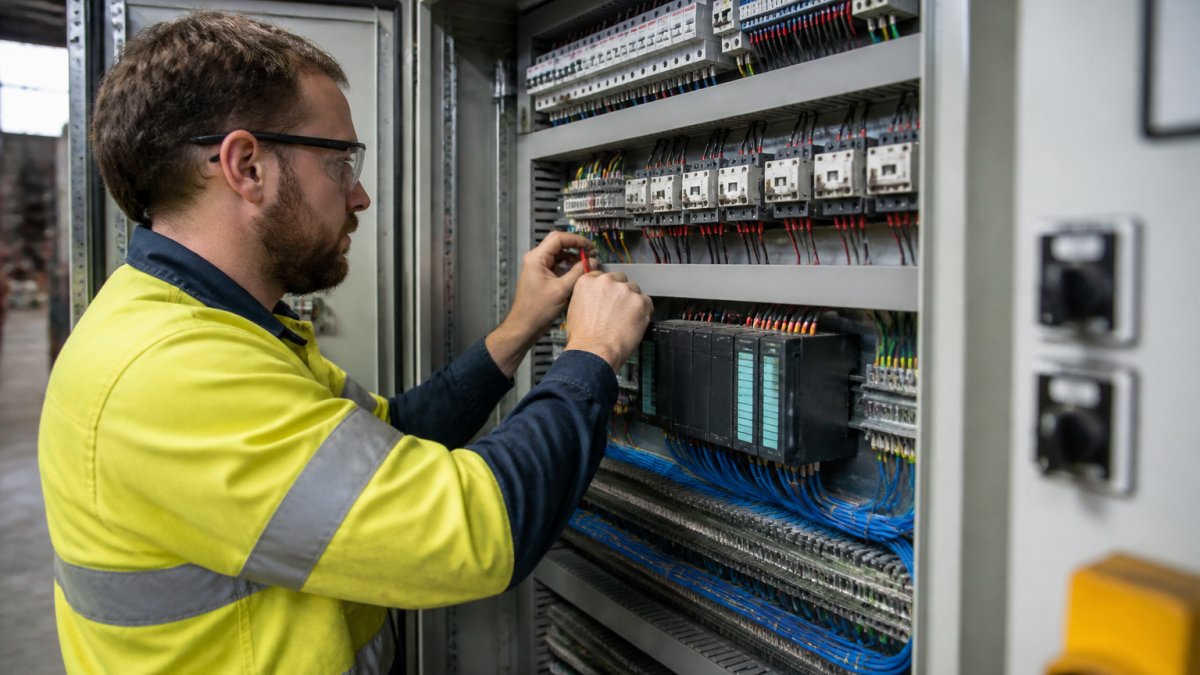
Good custom control panel design starts with segregation: power, control and signal wiring kept apart so electrical noise does not corrupt readings. Layout follows function, not convenience.
Key layout choices:
- Clear separation of mains voltage and low-voltage signals
- Labelling that matches the drawings exactly
- Room for expansion, because you will need it
Watch out: a panel built without as-built drawings becomes a liability within a year. Insist on documentation as a deliverable, not a favour.
PLC Programming and Installation, Plus HMI and I/O Choices
PLC programming and installation turns the design into behaviour. The programmable logic controller runs the control logic; the human-machine interface gives operators a clear view and safe control.
Match the controller to the job. Small, fast processes need less; multi-line plants with data logging need more memory and communications. Oversizing wastes money. Undersizing locks you in.
For the operator interface, keep it plain:
- Show what operators need to act on, not every data point
- Use consistent alarm priorities
- Log events so faults can be traced later
I/O configuration deserves the same care. Every input and output should be labelled, ranged and tested before it goes live.
Control System Commissioning and Acceptance Testing
Commissioning custom control systems is the staged process of proving they work safely and correctly before handover. It is where good projects and bad ones separate, and the phase most often compressed when a shutdown window tightens.
Work through it in order, with each stage signed off before the next begins:
- Bench test the panel and logic before site connection, prove every output fires and every input reads correctly with the panel isolated
- Point-to-point checks on every I/O, a wire-by-wire verification against the I/O list, with results recorded, not just ticked
- Dry runs with equipment isolated, logic sequences exercised without product or process, so faults are found before energy is applied
- Wet commissioning with product or process running, the first real test of the design against actual material behaviour
- Performance runs against the success measures agreed at the start, sustained, not a single good hour
Factory Acceptance Testing vs Site Acceptance Testing
Two distinct gates matter, and conflating them is a common cause of disputes.
Factory acceptance testing (FAT) happens before the panel leaves the workshop. The panel is powered, PLC and HMI programs are loaded, I/O is simulated, alarms are triggered, and the customer witnesses the result against an agreed test script.
Site acceptance testing (SAT) happens after installation and commissioning on site.
Running FAT with the customer's maintenance team present lets the people who will own the system see it proven before it arrives.
Defining Measurable Success Criteria
Acceptance testing needs written criteria agreed before design begins, not negotiated at handover. "It works" is not a criterion. Useful criteria are specific, measurable and tied to the process:
- Throughput: line reaches rated output within an agreed tolerance for a full shift, not a single run
- Quality: product meets specification across the full operating envelope, including changeover between formats
- Availability: unplanned stops fall below an agreed threshold over a defined trial period
Write these into the commissioning plan and reference them in the handover documentation. If a criterion cannot be measured, it is not a criterion, it is an opinion.
Commissioning Records You Should Receive
At handover, ask for the commissioning evidence pack: point-to-point check sheets, FAT and SAT results with signatures, loop tuning records, alarm and interlock test records, calibration certificates, and a punch list showing every open item with an owner and date.
If a supplier cannot produce these records, it is worth asking why, as gaps in commissioning documentation can lead to problems later in operation.
Industrial Control Panel Maintenance After Handover
Industrial control panel maintenance is planned inspection and testing that keeps the system reliable after the warranty ends. It is the cheapest insurance you will buy.
A practical routine:
- Thermal scans of terminals and connections
- Cleaning of filters and cooling paths
- Tightening checks on high-current terminations
Repeat alarms can serve as early warnings of developing faults and are worth investigating rather than dismissing.
Budget Drivers, Schedule and Network Security
Cost in a control project is driven largely by scope, including I/O count, panel complexity, programming hours, shutdown constraints and the state of existing documentation. Understanding the drivers can help you review a quote more carefully.
What Actually Drives the Budget
The main cost drivers, roughly in order of impact:
- I/O count and signal mix, every additional point carries wiring, termination, programming and testing time; analogue and specialty signals cost more than simple digital ones
- Panel complexity, segregation, labelling, expansion room and documentation all add workshop hours, and a panel built to be maintained costs more upfront and far less over its life
- Programming and configuration hours, sequence complexity, recipe handling, data logging and integration with existing systems are the largest variable
Pricing depends on your site, so a quote is best prepared after a site review. Contact our team to arrange a site assessment and a clear scope.
How the Schedule Actually Runs
Schedule follows the same logic as cost. Engineering and panel build can usually run in parallel, but installation waits on both, and commissioning waits on installation. Long-lead items and shutdown availability set the pace more often than engineering does.
A realistic sequence looks like this:
- Discovery and requirements, typically one to three weeks, depending on how much documentation exists
- Design and panel build, commonly four to ten weeks, with long-lead components ordered early
- Installation, fitted to your shutdown windows, which may stretch the calendar even when the work itself is short
- Commissioning and acceptance, one to four weeks including the trial period
Two schedule traps are worth naming. First, ordering long-lead items before design is frozen, it feels fast and usually causes rework. Second, treating the shutdown window as the only constraint, access, permits, inductions and isolation procedures all consume time inside the window and should be planned before it opens.
Network Security Belongs in the Budget From Day One
Modern control systems are connected systems, and connectivity is a security decision as much as an engineering one. Retrofitting security after commissioning is expensive and disruptive; designing it in costs far less.
The practical controls are well established:
- Segmentation, keep control networks separate from office and business networks, with controlled, documented paths between them where data must flow
- Access control, restrict who can reach programming ports and engineering workstations, and remove default credentials before handover
- Backups, keep PLC and HMI program backups offline and version-controlled, so a corrupted or tampered program can be restored quickly
As the Australian Cyber Security Centre advises, operational technology needs protection planned in, not bolted on. The same guidance emphasises knowing what is on your network and limiting access to it, both of which are design decisions, not afterthoughts.
A Simple Decision Guide
| Situation | Better choice | Why |
|---|---|---|
| Sound panels, dated logic | Retrofit | Lower cost, less downtime |
| Missing drawings, no spares | Replacement | Safety and support risk |
| Single line, tight budget | Targeted upgrade | Fixes the weak point only |
| Multi-line, growth planned | Full architecture review | Avoids repeat work |
Use the guide to frame the conversation, not replace it. The right answer depends on what the site review finds, and a supplier who will not explain their reasoning against these drivers is worth questioning.
Frequently Asked Questions
What are the main stages of custom control systems design and installation?
A typical project runs through six stages: gathering application requirements and process goals, system architecture and component selection, control panel design and fabrication, PLC programming and installation, control system commissioning with acceptance testing, and handover with documentation and training. Each stage produces a deliverable the next one depends on, so skipping requirements work or testing tends to surface as rework during commissioning. Ask your provider for a written stage plan with sign-off points before work starts.
Can you work with legacy PLC equipment and minimal documentation, or does everything need replacing?
Legacy equipment is workable in many cases. The first job is tracing what is actually installed and building as-built drawings, because undocumented panels are common in older plants. From there, the retrofit-or-replace call depends on spare parts availability, whether the existing controller can talk to new I/O and HMIs, and safety compliance. A partial upgrade that keeps working drives and replaces only the control layer often costs less than a full rip-out, but it needs a clear boundary so old and new equipment are properly integrated.
How are industrial control systems tested and commissioned?
Commissioning usually starts with factory acceptance testing, where the panel and control logic are checked off site against the design. On site, point-to-point I/O checks confirm every sensor and actuator is wired and addressed correctly, then dry runs and wet runs test sequences with and without product. Site acceptance testing proves the system meets the agreed performance criteria, such as cycle times, alarm behaviour and fail-safe states. Insist on documented test records, because they double as evidence for auditors and future maintenance.
How often should industrial control panels be inspected and maintained?
Most industrial sites schedule a full panel inspection annually, with more frequent checks in dusty, hot or washdown environments such as food and beverage plants. A routine inspection covers thermal scanning of terminations, tightening connections, cleaning filters and cooling paths, checking contactor and relay condition, verifying backup batteries, and reviewing alarm logs. Between inspections, keep a fault log so recurring trips are investigated rather than reset. Planned industrial control panel maintenance is far cheaper than unplanned downtime.