 how-to
Do You Need Industrial Electrical Emergency Repair Services?
Last Updated: October 28, 2026
Quick Summary
You need industrial electrical emergency repair when a fault stops production, endangers people, or risks damaging plant and stock, such as a tripped main switchboard or a phase failure on a production line. Emergency repair differs from routine maintenance, so anything that threatens product, people, or a compliance obligation is treated as an emergency. Call a qualified electrician with the symptoms rather than attempting a reset yourself.
- Triage ranks each major load before an incident so the site team knows what to protect first.
- Never repeatedly reset a protective device to see if it holds, as this can turn a repairable failure into a fire.
- Keep spares for known failure points so a multi-day wait for a part becomes an hour-long swap.
- A repeat trip after a repair means the diagnosis was incomplete, so stop and reassess.
- Record test results, replaced parts, and temporary repairs, as auditors often ask for this record first.
Table of Contents
- What Counts as an Industrial Electrical Emergency
- Industrial Electrical Fault Finding: How the Root Cause Gets Found
- Industrial Power Failure Response: Triage and Safe Shutdown
- Building an Electrical Emergency Response Plan Before You Need One
- The Industrial Equipment Restart Checklist
- Downtime, Documentation and What the Repair Actually Costs
- Book an Industrial Electrician for Your Site
- Frequently Asked Questions
What Counts as an Industrial Electrical Emergency
An industrial electrical emergency is any fault that stops production, endangers people, or risks damaging plant and stock.
The distinction matters because emergency repair is not the same as routine maintenance. A flickering light in an office can wait until Monday. A failed feeder to a refrigeration compressor cannot.
- Total power failure on a production line or cold storage area
- Switchboard faults, including burnt contacts, tripped mains, and arcing
- Equipment failure that halts a process, such as a drive or motor starter
Anything that threatens product, people, or a compliance obligation is an emergency. Everything else is a scheduled job.
Industrial Electrical Fault Finding: How the Root Cause Gets Found
Industrial electrical fault finding is a structured diagnostic process, not guesswork. A structured diagnostic process can involve isolating the fault, testing the circuit, and confirming the cause before a repair.
The aging panel that trips twice a month is a good example. That pattern usually points to a failing component, loose termination, or insulation breakdown, not a random nuisance trip.
From Symptom to Circuit: The Diagnostic Sequence
- Gather the symptoms. What tripped, when, and what was running at the time.
- Isolate the circuit. Confirm what is dead and what is still live.
- Test at the switchboard. Check supply, phase balance, and protection devices.
- Trace to the equipment. Test the motor, drive, or control circuit.
- Confirm the root cause. Replace or repair only once the cause is proven.
- Re-test under load. Verify the repair holds when the line runs.
Watch out: patching a symptom without confirming the cause is the most common reason a fault comes back. A replaced fuse tells you nothing about why it blew.
Industrial Power Failure Response: Triage and Safe Shutdown
Industrial power failure response starts with triage: decide what must stay energised, what must be shut down safely, and who needs to know. Get that order right and you protect people, product, and equipment at the same time.
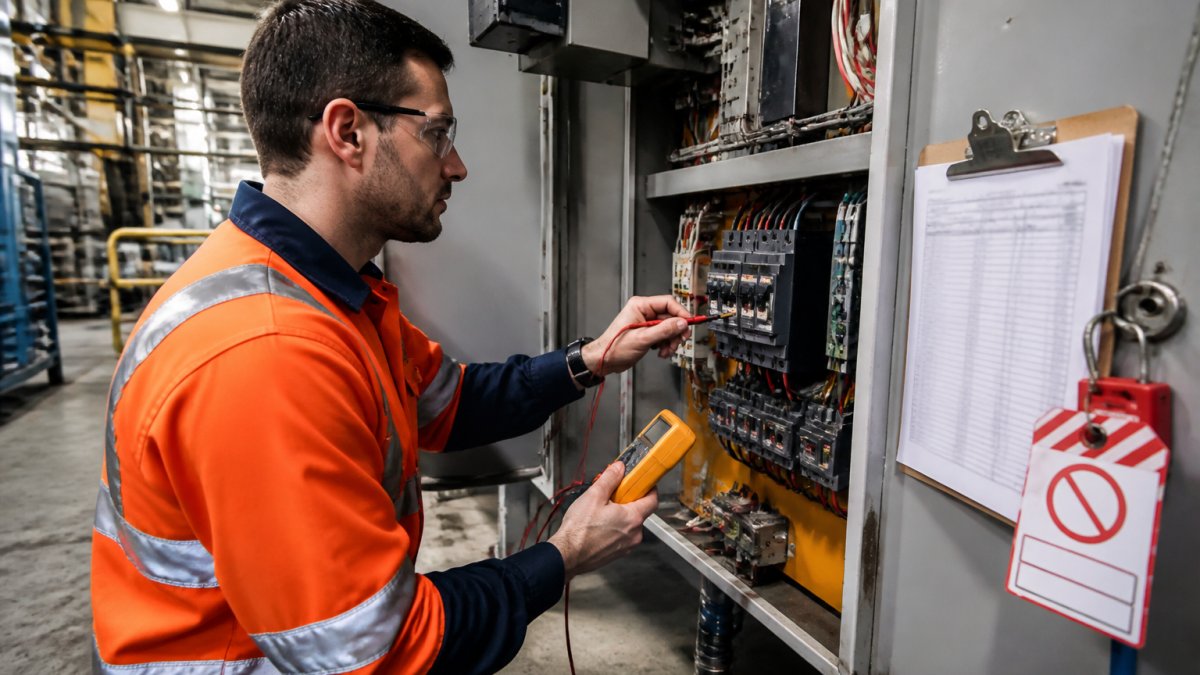
Triage: Decide What Stays On Before You Touch Anything
Triage is a ranking exercise, and it should be done before an incident, not during one. A practical three-tier split works for most plants:
- Tier 1, life safety and environmental protection: emergency lighting, fire pumps, fume extraction, effluent pumps, and any load that keeps people safe or prevents a discharge.
- Tier 2, product and process protection: refrigeration, cold storage, ovens holding temperature, and pumps or agitators that prevent a batch from setting or spoiling.
- Tier 3, production output: conveyors, drives, packaging lines, and other loads that cost money per hour but do not create a safety or spoilage risk.
Write the tier for each major load on a single sheet and post it at the main switchboard. When the power fails, the sheet tells the site team what to protect first while the electrician is on the way.
Safe Shutdown: The Isolation Sequence
A safe shutdown is a sequence, and it should already be written down. Never let anyone reset a main breaker to "see if it holds." A breaker that trips again under fault current is doing its job; resetting it into a known fault can turn a repairable failure into a fire or an arc-flash incident.
Work through isolation in this order:
- Confirm no one is working on the affected equipment. Check permits, tags, and radio contact with maintenance before anything is switched.
- Identify the faulted circuit. Note which protective device operated, main switch, sub-main, MCC bucket, or RCD, because that tells the electrician where to start.
- Isolate and lock out. Open the upstream isolator, apply a personal lock and danger tag, and test for dead at the point of work before anyone touches conductors.
- Protect temperature-sensitive stock. Move product to backup cooling or a secondary store, and record temperatures and times so spoilage decisions can be made later.
- Record the state of the plant. Note what was running, what tripped, any alarms, and any smell, noise, or smoke observed. This log is the single most useful thing you can hand the electrician.
- Call your electrician with the symptoms, not just "the power's out." Say which device tripped, what was running, and whether anything is visibly damaged.
What Not to Do While You Wait
A few habits cause more damage than the original fault:
- Do not repeatedly reset a protective device to "see if it holds."
- Do not open switchboard doors or MCC buckets to look inside unless you are authorised and appropriately trained.
- Do not run extension leads across wet floors to keep a Tier 3 load alive.
A written triage sheet, a posted isolation sequence, and a disciplined no-reset rule cover most of what a site team can safely do before the electrician arrives. Everything beyond that belongs to the qualified trade.
Triage ranks each major load before an incident so the site team knows what to protect first.
| Tier | What it covers | Example loads |
|---|---|---|
| Tier 1 | Life safety and environmental protection | Emergency lighting, fire pumps, fume extraction, effluent pumps |
| Tier 2 | Product and process protection | Refrigeration, cold storage, ovens holding temperature, pumps and agitators |
| Tier 3 | Production output | Conveyors, drives, packaging lines |
Building an Electrical Emergency Response Plan Before You Need One
An electrical emergency response plan is a written set of contacts, isolation steps, and priorities that your team follows the moment power fails. The best time to build one is a quiet Tuesday, not during a breakdown.
A plan can include names and numbers, not just principles:
- Emergency contact details for your electrical provider, posted at the switchboard
- Isolation points marked on a site map
- Priority loads listed by area, so triage is decided in advance
- Who authorises a call-out after hours
Review it each year and after any upgrade. A plan nobody has read is worse than no plan, because it creates false confidence.
The Industrial Equipment Restart Checklist
An industrial equipment restart checklist is the step-by-step sequence for bringing plant back online safely after a repair. Restarting too fast is how a fixed fault becomes a second failure.
Work through it in order:
- Confirm the repair is complete and tested
- Remove locks and tags only when authorised
- Restore supply at the switchboard, one circuit at a time
- Start critical equipment first and watch for abnormal noise or heat
- Bring production lines up in sequence
- Record readings and any anomalies in the fault log
- Monitor for the first shift before returning to full load
If anything trips again, stop. A repeat trip after a repair means the diagnosis was incomplete.
Downtime, Documentation and What the Repair Actually Costs
Downtime is usually the largest cost in an electrical breakdown, not the repair itself. Lost production, spoilage, wasted labour, and missed deliveries add up faster than most plant managers expect.
What Drives the Cost of an Emergency Repair
- Call-out and attendance: a fee to get a qualified electrician to site, which is higher outside standard business hours, on weekends, and on public holidays.
- Labour time: charged from attendance until the fault is diagnosed and either repaired or made safe, including travel between sites.
- Parts and replacement equipment: breakers, contactors, overloads, drives, cable, and terminations. Long-lead items such as a specific drive or motor can dominate the bill and the downtime.
- Access and isolation requirements: whether the fault is in an accessible MCC or behind a production line that must be stripped down, and whether a shutdown window is needed to work safely.
Reducing Downtime While the Repair Is Underway
You cannot always shorten the repair, but you can shorten the outage:
- Prioritise critical loads. Bring Tier 1 and Tier 2 loads back on temporary supply where it is safe to do so, and leave Tier 3 until the repair is complete.
- Use temporary restoration deliberately. A temporary repair or bypass can keep a critical process running, but it must be documented, tagged, and scheduled for permanent repair, not left in place indefinitely.
- Plan the restart before the repair finishes. Decide the start sequence, who is on the floor, and what readings will be checked, so restart begins the moment the electrician signs off.
- Keep spares for known failure points. Critical breakers, contactors, and fuses held on site turn a multi-day wait for a part into an hour-long swap.
Documentation and Post-Incident Records
Documentation matters as much as the fix. Keep test results, replaced parts, fault history, and any temporary repairs on file. If you are facing a compliance audit, that record is often what auditors ask for first, and it also gives the next electrician a head start.
A useful post-incident record covers:
- Date, time, and duration of the outage
- Which protective device operated and what was running at the time
- Symptoms observed before attendance
- Tests performed and results
For a clearer picture of what a job involves, see our full range of electrical services.
Book an Industrial Electrician for Your Site
When a fault stops your line, the priority is a qualified electrician who can diagnose it properly and get you running again. Industry Power Solutions provides industrial automation and tailored electrical services, including PLC programming and custom control systems.
If you are ready to move, you can contact our team.
Frequently Asked Questions
What should you do during an industrial electrical emergency?
Make the area safe first. Isolate the affected circuit at the switchboard if it can be done without touching damaged equipment, keep staff clear, and call an electrician. Do not reset breakers repeatedly to force production back on, because a fault that trips twice is a fault that needs diagnosis. Note what happened, when, and which equipment stopped, then pass that to the electrician. Keep a record for any incident reporting.
How quickly can an emergency repair service respond to a site?
Response times depend on your location, the time of day and the electrician's current workload, so ask for a realistic arrival window rather than an optimistic one. Rural and regional sites often sit further from available crews, which is why an electrical emergency response plan should name a provider in advance and confirm coverage for your area. Industry Power Solutions can confirm service availability and the earliest visit for your site when you call.
What information should you give an emergency electrical repair service?
Give the site address and access details, a contact who will be on site, the nature of the fault, and whether anyone is in danger. Describe the equipment involved, its age, and whether it is three-phase. Mention any PLC or control system affected and whether documentation exists. If you have photos of the switchboard or the damaged component, send them.
What should be checked before restarting industrial equipment after a repair?
Work through an industrial equipment restart checklist: confirm the repair is complete, check that protective devices are correctly rated and reset, and confirm guards and interlocks are back in place. Bring equipment back in sequence rather than all at once. Log the repair and monitor the first production run for anything unusual.
A breakdown never waits for a convenient moment. If your switchboard is tripping, your PLC is faulting, or an audit has flagged your infrastructure, Industry Power Solutions can assess the site, find the root cause, and document the repair. Get started with Industry Power Solutions and keep your plant running.